
📋 Quick Summary
- What Causes Granite Countertops to Crack?
- What Is the Difference Between a Hairline Crack and a Structural Crack?
- Can a Cracked Granite Countertop Be Repaired?
- How Professional Granite Countertop Crack Repair Works
- Can a Granite Crack Be Repaired Without Replacing the Countertop?
- Should You Repair or Replace a Cracked Granite Countertop?
- Why Choose Tri-State Countertop Repair?
- Final Thoughts
Granite is highly durable, but it can still crack. A crack may appear after an impact or develop because of stress, movement, inadequate support, or installation problems. Understanding why granite countertops crack matters because the visible line may be only part of the problem.
A cracked granite countertop does not automatically require replacement. Depending on the location, size, cause, and surrounding stone, professional granite countertop crack repair may restore the surface. Tri-State Countertop Repair provides granite, marble, and quartz repair and restoration across Pennsylvania, including bonding, reinforcement, color-matched filling, and refinishing.
What Causes Granite Countertops to Crack?
🔑 Key Insight
Granite is strong, but cracking can occur when stress is concentrated in a vulnerable area or when the countertop experiences excessive movement or impact.
1. Heavy Impact
One of the most common causes of granite countertop cracks is a strong impact. Dropping a heavy pot, cast-iron pan, appliance, or other hard object onto the countertop can create a chip or fracture. Edges and corners are particularly vulnerable because an impact is concentrated over a smaller area.
Heavy cookware striking a granite edge can cause cracks that initially appear minor but become more noticeable with continued use. Professional inspection is useful when a crack appears immediately after an impact.
2. Stress Around Sink Cutouts
The granite surrounding a sink opening can be relatively narrow compared with the rest of the slab. This area may experience repeated stress from daily kitchen activity, especially when heavy pots and dishes are moved around the sink.
Cracks around sink cutouts can also be associated with insufficient support or movement. A professional repair should therefore evaluate both the crack and the surrounding installation rather than simply filling the visible line.
3. Stress Around Cooktop Cutouts
Cooktop openings create another area where granite can be vulnerable. The corners and narrow sections around the opening may experience concentrated stress. Improper fabrication, inadequate support, or impact can contribute to cracking in these areas.
A crack near a cooktop should be evaluated to determine whether the opening or support system is contributing to the damage.
4. Improper or Inadequate Support
Granite is heavy and requires appropriate support. If cabinets are uneven, damaged, poorly aligned, or insufficiently supported, the countertop can experience stress that was not present during installation.
Unsupported overhangs can create additional leverage. When the stone flexes or moves, a weak point may eventually develop into a crack. Tri-State Countertop Repair specifically identifies unsupported overhangs and support correction as factors that may need attention during countertop crack restoration.
5. Cabinet Settlement and Structural Movement
Homes naturally experience some movement over time. Settlement, changes in supporting structures, or movement of cabinets can place stress on a rigid granite countertop. Because granite does not flex like some other materials, movement in the supporting structure can transfer stress to seams, cutouts, and other vulnerable areas.
If a repaired crack returns, the cause may need to be investigated rather than simply repairing the same line again.
6. Poor Installation or Fabrication
Installation quality can affect the long-term performance of granite. Poorly positioned seams, inadequate support, improper cutouts, insufficient reinforcement, or uneven cabinetry can create stress points.
A crack without an obvious impact deserves evaluation to determine whether installation or support conditions are contributing.
7. Excessive Weight or Concentrated Pressure
Granite can support substantial everyday loads, but concentrated pressure in the wrong location can create problems. Sitting, standing, or placing unusually heavy objects on unsupported sections or overhangs may put excessive stress on the stone.
Overhangs need appropriate support; do not use them as seats or structural supports.
What Is the Difference Between a Hairline Crack and a Structural Crack?
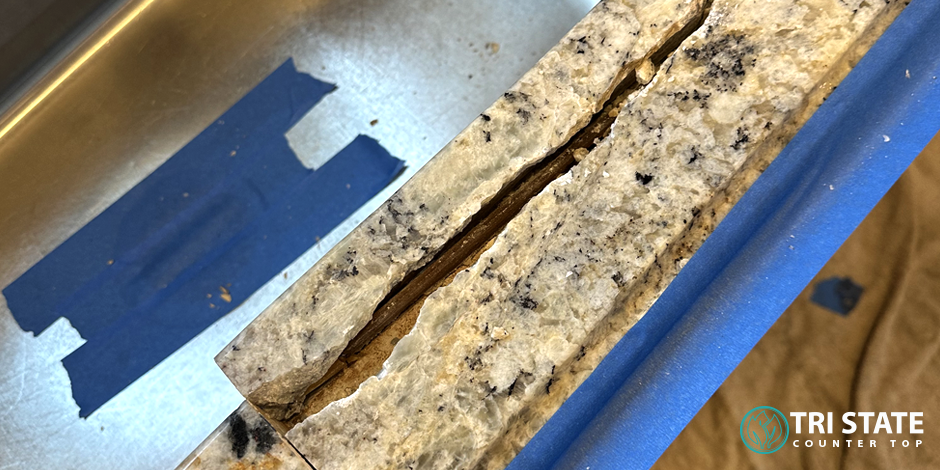
Not every crack has the same significance. A hairline fracture may be cosmetic, while a wider or moving crack may indicate a structural issue.
Appearance alone does not determine severity. A small crack near a sink, cooktop, seam, or unsupported area may need prompt attention, while a longer crack can sometimes be repaired if the countertop remains stable.
Assessment should consider location, depth, movement, support, and additional damage.
Can a Cracked Granite Countertop Be Repaired?
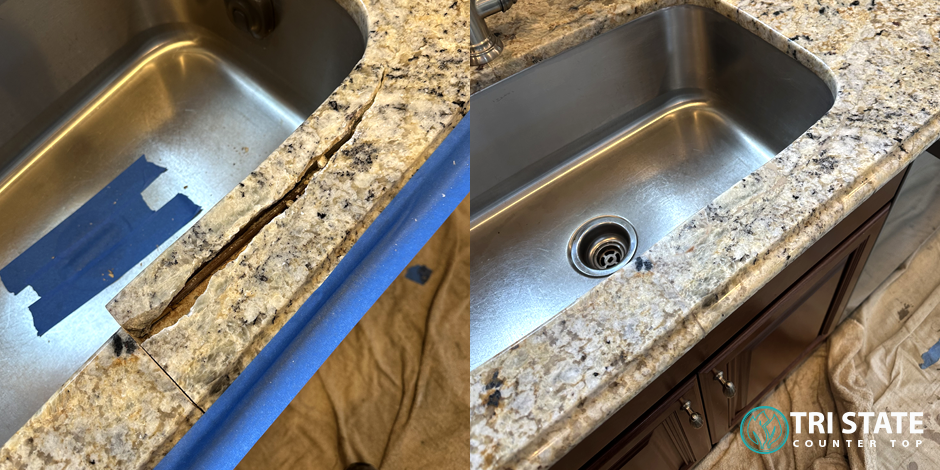
In many cases, yes. Professional granite countertop repair can involve bonding, reinforcement, filling, color matching, leveling, and refinishing. Tri-State Countertop Repair states that its countertop crack restoration service repairs marble, quartz, and granite cracks and includes bonding, reinforcement, color-matched filling, and refinishing.
The method depends on the stone's condition. A localized crack in stable granite may be suitable for restoration, while extensive fractures, severe movement, missing stone, or failing support may favor replacement.
How Professional Granite Countertop Crack Repair Works
Step 1: Diagnose the Cause
The technician examines the crack and surrounding countertop to determine its likely cause and extent. This is important because repairing the visible line without addressing movement or inadequate support may not provide a lasting result.
Step 2: Prepare the Damaged Area
The crack and surrounding stone are cleaned and prepared. Existing repair materials may need to be removed when they interfere with the restoration process.
Step 3: Bond and Reinforce
Appropriate professional repair materials are used to stabilize the damaged area. Depending on the situation, reinforcement may be required around vulnerable sections.
Step 4: Fill and Color-Match
The crack is filled with a suitable material and, when appropriate, color-matched to the granite. Natural granite contains unique mineral patterns, so the goal is to minimize the visual contrast rather than promise an identical reproduction.
Step 5: Level and Refinish
After the repair material cures, the area is refined and finished. Professional refinishing can help the repaired section blend more naturally with the surrounding countertop.
Can a Granite Crack Be Repaired Without Replacing the Countertop?
Often, yes. If the crack is localized and the countertop remains stable, repair may be a practical alternative to replacement. This can preserve a granite slab that homeowners already like and avoid the disruption associated with removing an entire countertop.
Replacement may be considered when there are multiple major fractures, extensive missing stone, unstable countertop sections, failing cabinets, or a renovation that already requires a new countertop layout. Current Tri-State guidance similarly emphasizes evaluating the cause and overall condition before deciding between repair and replacement.
Should You Repair or Replace a Cracked Granite Countertop?
Consider professional repair when the damage is localized, the slab is stable, and you want to preserve the existing granite.
Consider replacement when the countertop has widespread structural damage, severe cabinet problems, extensive missing stone, or a layout that no longer meets your needs. If a complete kitchen renovation is already planned, replacement may be more practical.
Why Choose Tri-State Countertop Repair?
Tri-State Countertop Repair is a family-owned, locally operated countertop restoration company serving Pennsylvania. The company provides granite repair and restoration, countertop crack repair, chip repair, polishing, and related stone services. Its current service information states that repairs are color-matched and refinished, with free on-site estimates available.
We determine whether damaged stone can be restored before replacement is considered.
If your granite countertop has developed a crack, chip, damaged edge, or seam problem, contact Tri-State Countertop Repair for professional evaluation and repair options. Visit www.tristatecountertoprepair.com to learn more.
Frequently Asked Questions
Why do granite countertops crack?
Common causes include heavy impact, stress around sink and cooktop cutouts, inadequate support, cabinet movement, settlement, installation problems, excessive pressure, and damage around existing chips or weak areas.
Can a cracked granite countertop be repaired?
Many localized cracks can be professionally repaired. The repair may involve bonding, reinforcement, filling, color matching, and refinishing. The condition of the surrounding countertop determines whether repair is appropriate.
Does one crack mean I need a new granite countertop?
No. A single crack does not automatically require replacement. A professional should evaluate the cause, location, stability, and extent of the damage before recommending repair or replacement.
Are cracks around granite sinks repairable?
Some sink-area cracks can be repaired, but support and stress should be checked first.
Final Thoughts
Granite countertops are designed to provide years of durable service, but cracking can occur when the stone experiences impact, movement, excessive pressure, inadequate support, or stress around cutouts and other vulnerable areas.
The most important step is not simply covering the visible crack. It is understanding why the granite countertop cracked and determining whether the underlying condition can be corrected. In many situations, professional granite countertop crack repair can restore localized damage and preserve an otherwise usable countertop.
If you are dealing with a cracked granite countertop, Tri-State Countertop Repair can evaluate the damage and explain the available repair or restoration options. Visit www.tristatecountertoprepair.com to request professional countertop repair information.